Children do not learn their first language through occasional lessons. Instead, they hear it throughout the day. They encounter the same words repeatedly and gradually begin connecting sounds with people, objects, actions, and emotions.
Second-language acquisition works in a similar way.
That is why consistency in language learning can make such a significant difference during early childhood. Regular exposure helps children become comfortable with unfamiliar sounds, remember new vocabulary, and gradually use another language more naturally.
At Global Minds Preschool, Spanish and Mandarin are integrated into everyday preschool experiences. As a result, language learning becomes something children regularly experience rather than a separate activity they occasionally practice.
Why Consistency in Language Learning Is So Important
Learning a new language requires the brain to create and strengthen connections between sounds, meanings, and situations.
However, those connections become stronger through repetition.
A child might hear a Spanish or Mandarin word for the first time and not immediately understand it. Then, the teacher may repeat that word during a song, activity, conversation, or classroom routine.
Eventually, context begins to make the meaning clear.
Consistent exposure gives children more opportunities to make those connections. Moreover, it removes some of the pressure associated with traditional memorization.
Children do not need to master every new word immediately. They can hear it repeatedly until understanding develops naturally.
Young Children Learn Language Through Everyday Experiences
One reason consistency matters is that young children learn differently than many adults.
Adults may study vocabulary lists or memorize grammar rules. Preschool children, however, often learn best by connecting language with experiences.
For example, a child can hear a new word while painting a picture. Later, the same word may appear during story time. Then, a teacher might use it again during play.
Each interaction reinforces the previous one.
Therefore, effective early language learning is not limited to a designated language lesson. Language becomes part of the child’s environment.
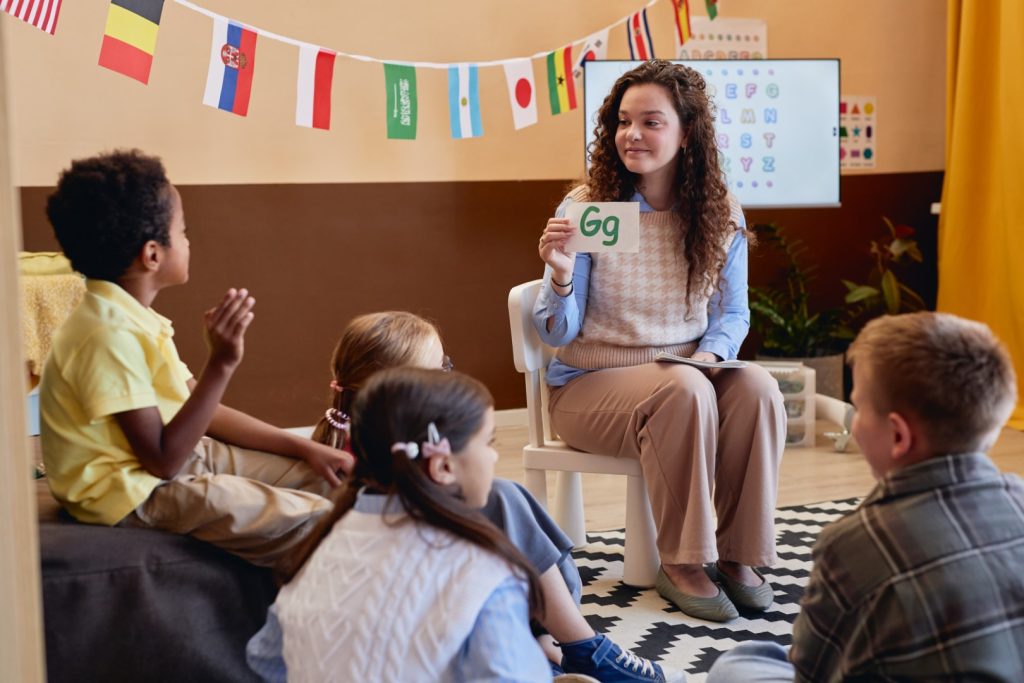
At Global Minds Preschool, Spanish and Mandarin can be incorporated into activities such as music, art, science, storytelling, movement, and play.
Consequently, children experience language while doing things they already enjoy.
Repetition Helps Turn Vocabulary Into Understanding
Parents may wonder whether repeating words and phrases becomes boring for children.
In reality, repetition is a fundamental part of early learning.
Consider how many times a toddler hears common English words before using them confidently. The same principle applies when children learn Spanish or Mandarin.
First, a child may recognize a sound.
Next, they may understand what the word means.
Later, they may begin responding appropriately when they hear it.
Eventually, they may start using the word independently.
This process does not happen according to a strict schedule. Every child learns differently. However, consistent exposure gives each child repeated opportunities to progress.
Immersion Creates Consistency Naturally
One challenge with occasional language lessons is the amount of time between learning opportunities.
A child might attend a short class once per week and then hear little of the language afterward. Therefore, every lesson may require time to revisit previously learned concepts.
Language immersion provides a different experience.
Instead of switching briefly into a new language, children hear and interact with it throughout their regular learning environment.
At Global Minds Preschool, teachers use tools such as gestures, facial expressions, demonstrations, role-playing, and classroom materials to communicate meaning.
Therefore, children do not always need an English translation to understand what is happening.
This creates an important connection between words and real experiences.
Consistency Helps Build Confidence
Language learning is not only about vocabulary.
Children also need confidence to experiment with unfamiliar sounds and expressions.
A supportive environment allows children to listen before they are ready to speak. Then, they can begin participating at their own pace.
As certain words and phrases become familiar, the language may feel less intimidating.
A child who once listened quietly may eventually sing along with a song. Later, that same child might answer a simple question or use a new expression without being prompted.
These small milestones can build upon one another.
Therefore, consistency in language learning supports both communication skills and confidence.
Language Learning Can Become Part of Play
Children naturally repeat activities they enjoy.
They may request the same book, sing the same song, or return to the same imaginary game repeatedly. Fortunately, this tendency makes play an excellent tool for language development.
When Spanish or Mandarin becomes connected with enjoyable experiences, children have additional reasons to engage with the language.
A teacher may introduce vocabulary during pretend play. Then, children can repeat those words while interacting with classmates.
Similarly, songs can reinforce pronunciation and vocabulary without turning the experience into a memorization exercise.
This is one reason Global Minds emphasizes playful, interactive learning.
The goal is not simply to teach children another set of words. Instead, children can begin experiencing another language as a normal way to communicate.
Can Parents Support Consistent Language Learning at Home?
Parents do not necessarily need to speak Spanish or Mandarin fluently to encourage language learning.
Instead, families can simply show interest in what their child is learning.
Ask your child to teach you a new word. Encourage them to sing a song they learned at school. Celebrate when they recognize something in another language.
Parents who speak Spanish or Mandarin can also use the language naturally at home.
However, there is no need to turn home life into another classroom.
Positive reinforcement can help children associate language learning with curiosity and accomplishment.
Most importantly, regular exposure at preschool provides an important foundation that families can encourage outside the classroom.
Why Early Childhood Is an Ideal Time to Build Consistent Habits
Preschool-aged children are constantly absorbing information from their surroundings.
They are already learning how conversations work, how to express themselves, and how words relate to the world around them.
Introducing another language during this stage allows Spanish or Mandarin to become part of that broader learning process.
Furthermore, early experiences can establish an important mindset.
Children begin to recognize that there is more than one way to communicate. They can also gain exposure to cultures, traditions, and perspectives beyond their immediate environment.
Therefore, consistent language learning can support much more than vocabulary development. It can encourage curiosity about people and the wider world.
Give Your Child the Advantage of Consistent Language Immersion
Consistency in language learning helps children move from simply hearing another language to gradually understanding and using it.
Through repetition, context, interaction, and play, new sounds begin to feel familiar. Words gain meaning. Meanwhile, children become more comfortable communicating.
Global Minds Preschool creates this consistency by integrating Spanish and Mandarin into everyday preschool learning. Children ages 18 months to 5 years can experience language alongside music, art, science, storytelling, creative play, and social development.
With campuses in Phoenix and Scottsdale, Global Minds offers families an opportunity to make language immersion part of their child’s early education.
If you are exploring a preschool where language learning happens naturally throughout the day, contact us at Global Minds Preschool. Schedule a tour and discover how consistent Spanish and Mandarin immersion can help your child build a strong foundation for future learning.